
ExeOutput for PHP
  • Discover
    Homepage
    Our Latest News and Articles

    Keep up-to-date with the latest developments, insightful articles.

    Why a PHP Compiler?

    Reasons for using our PHP compiler ExeOutput for PHP.

    Screenshots

    Get a visual tour of our software through various screenshots.

    Video and Screencasts

    Access a range of video content, from detailed tutorials to product demos.

  • Feature Tour
    All-in-one PHP to EXE Compiler
    Use PHP power to create Windows apps
    Full HTML5, JavaScript and CSS3 Support
    Make GUI And Console Apps with PHP
  • Downloads
    Get ExeOutput for PHP

    Download the installer of our PHP to EXE compiler

    PHP App Examples

    Download sample apps made with ExeOutput for PHP

    WordPress Desktop App

    Download the stand-alone WordPress app sample

  • Buy Now
  • Learn
    Documentation

    Full online documentation of ExeOutput for PHP

    PHP App Samples

    Example projects made with ExeOutput for PHP for various cases

    ChangeLog

    Version history and releases of ExeOutput for PHP

    Privacy Policy

    See our Privacy Policy for ExeOutput for PHP

    About Us

    More information about G.D.G. Software

  • Support
    Contact Us

    Contact our staff or open a support ticket

    Newsletter

    Stay Updated: subscribe to our newsletter

    Frequently Asked Questions

    Find your answer directly in our FAQ

    Support Center

    Get direct support for ExeOutput for PHP

    Affiliate Program

    Join our affiliate program to promote ExeOutput and earn money

    Community Forum

    Visit our support forum and ask your questions

Try For Free
My Account

Getting Started

11
  • Welcome to ExeOutput for PHP
  • Getting Started
  • Starting a New Project
  • Advice for Getting Started with PHP Applications
  • How to Compile Your Project
  • How Compiled PHP GUI Applications Work
  • How Compiled PHP Console Applications (CLI) Work
  • Using PHP Frameworks
  • Visual C++ Redistributable Requirement
  • Application Command Line Switches
  • PHP Samples

Working With PHP

12
  • Working with PHP
  • Choose a PHP Version
  • Accessing Files in Compiled PHP Applications
  • Saving Files with PHP in Desktop Applications
  • Solving PHP Errors
  • Using the Save As Dialog Box in PHP Applications
  • Selecting Local Files with PHP (File Upload Replacement)
  • Built-In ExeOutput for PHP Functions
  • About PHP Sessions and Cookies
  • Global Variables
  • Using the cURL Extension
  • Using exec(), system() in Applications

Databases

4
  • Using Databases in Applications
  • MySQL and MariaDB Support
  • Using a Portable MySQL (MariaDB) Server
  • How to Check MySQL Server Connection

JavaScript And Browser

14
  • JavaScript and the Chromium Browser
  • Developer Tools in ExeOutput Applications
  • The exeoutput JavaScript Object API
  • JavaScript window extension
  • Special Protocols for Links
  • HTML5 and CSS3 Support
  • Using HTML5 Video and Audio
  • Print, Kiosk Printing, and PDF
  • Opening New Windows
  • JavaScript window extension
  • Using Flash Objects (SWF) in Compiled Applications
  • Adding Custom Headers to Requests
  • How to Configure Proxy for Your App
  • HTTP Basic Authentication

File Manager

4
  • File Manager
  • File Properties Editor
  • About External Files
  • Internal Code Editor

Application Settings

9
  • Choosing and Configuring the Rendering Engine
  • Chromium Embedded Framework (CEF) Settings
  • WebView2 Rendering Engine Settings
  • Main Window Settings
  • UI Skin Properties
  • Application Components
  • Language and Localization
  • Startup and Exit Messages
  • Application Settings – Dialog Boxes

PHP Settings

7
  • PHP Settings – Main Settings
  • PHP Settings – PHP Extensions
  • PHP.ini Settings
  • PHP Settings – String Protection
  • PHP Settings – PHP Debugging
  • PHP Settings – External HTTP Server
  • Redirection and Routing

User Interface

13
  • User Interface Components
  • User Interface Editor
  • UI Control Actions
  • How to Modify Controls at Runtime
  • Status Bar Properties
  • Printer Properties
  • Tray Icon Properties
  • Context Menu Properties
  • Creating a Ribbon for Your Application
  • Toolbars in Your PHP Application
  • Menu Bar in your PHP application
  • Adding an Image or Logo to the UI
  • Using Timers and Cron Jobs in Your Application

Security

4
  • Security – Global Protection
  • Security – PHP Protection
  • Security – Code Signing (Digital Signatures)
  • Security – Licensing

Application Output

5
  • Application Output Settings
  • Output – Deployment Options
  • Application Loading Screens
  • Output – EXE Icon and Version Information
  • Output – Creating Installers or Zip Archives

Scripting with HEScript

9
  • Introduction to Scripting with HEScript
  • The HEScript Editor
  • Adding HEScript Code to Your Application
  • Script Templates
  • Running and Calling HEScript Procedures/Functions
  • HEScript Function Reference
  • How to Run an Executable Program
  • How to Prompt a User for Their Name Once and Store It
  • How to Call DLL Functions

Additional Information

6
  • Environment Options
  • Technical Notes Regarding Applications
  • Cloning a Project
  • Command Line Options
  • Contact Information
  • About this documentation
View Categories
  • Home
  • ExeOutput for PHP Help
  • Application Settings
  • Choosing and Configuring the Rendering Engine

Choosing and Configuring the Rendering Engine

2 min read

Choosing a Rendering Engine #

ExeOutput for PHP gives you the flexibility to choose between two powerful HTML rendering engines for your application: Microsoft Edge WebView2 and the Chromium Embedded Framework (CEF). Both are based on the Chromium project, ensuring modern web standards compatibility, but they differ significantly in how they are integrated and distributed.

Your choice of engine impacts your application’s final size, its dependencies, and some of its features, such as media playback. To select an engine, navigate to Application Settings → Rendering Engine.
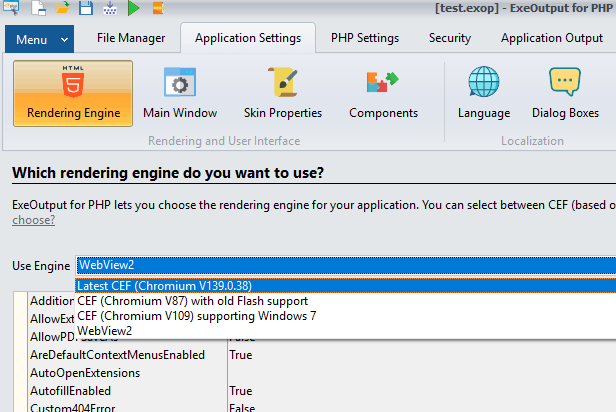
WebView2 or CEF engine

Comparison: WebView2 vs. CEF #

Here is a summary of the key differences to help you decide which engine is best for your project:

FeatureMicrosoft Edge WebView2Chromium Embedded Framework (CEF)
Core TechnologyMicrosoft Edge (Chromium)Embedded Chromium (Version 139.0.38 in ExeOutput 2025)
DistributionUses the WebView2 runtime installed on the system.All framework files are bundled inside your EXE.
Application SizeVery small (approx. 20 MB).Large (approx. 150 MB).
DependenciesRequires the WebView2 runtime on the end-user’s PC.None. Creates a fully self-contained, portable application.
Updates“Evergreen”: automatically updated by Windows Update.Bundled version is updated only when you recompile with a new ExeOutput version.
Media Codecs (MP4/H.264)Supported by default.Not supported by default due to licensing. Requires a special licensed build.

When to Choose WebView2 #

We recommend WebView2 for most new projects. Choose it if:
* You want the smallest possible application size for faster downloads and installation.
* You need to support modern web features and want your app’s rendering engine to be automatically updated with the latest security patches by the operating system.
* Your application requires MP4/H.264 video playback without needing special licenses.

Warning

Known Issue: File Uploads in Forms
There is currently a bug in the Microsoft Edge WebView2 engine that may prevent file uploads (<input type="file">) from working correctly with PHP (see bug report here).

As a workaround, you can either use the CEF engine (which does not have this issue) or implement a native file selection dialog as explained in the topic on how to select local files with PHP. This requires some additional code but provides a reliable solution.

When to Choose CEF (Chromium Embedded Framework) #

CEF is an excellent choice when portability is your top priority. Choose it if:
* You need to create a fully self-contained and portable application with zero external dependencies.
* You require precise control over the exact version of the Chromium engine used by your application.
* You are targeting environments where you cannot guarantee the presence of the WebView2 runtime and prefer not to handle its installation.

Engine Configuration #

Both engines offer a wide range of properties that can be configured in the Application Settings → Rendering Engine section of ExeOutput for PHP.

Configuring WebView2 #

The WebView2 engine provides several options to control its behavior, such as context menus, autofill, and developer tools.

👉 Learn more about configuring the WebView2 engine

Configuring CEF #

The CEF engine offers extensive customization, from command-line arguments to fine-grained control over caching, security, and JavaScript.

  • MP4/H.264 Support: The default CEF build only supports open-source codecs like WebM and Ogg. Playback of licensed formats like MP4/H.264 requires a special build. If you need this, we recommend using WebView2 or contacting us for a licensed CEF build (requires a valid MPEG license from Via Licensing Alliance).
  • Flash Support: For legacy projects requiring Adobe Flash, an older CEF version with Flash support is available. However, we recommend using the modern Ruffle.rs alternative.

👉 Learn more about configuring the CEF engine

Distributing Applications with WebView2 #

Because WebView2 relies on a runtime component, you need to be aware of its distribution model.

  • The WebView2 runtime is included by default on Windows 11 and most recent versions of Windows 10.
  • For older systems (Windows 7, 8.1, or older Windows 10), the runtime may need to be installed.
  • ExeOutput for PHP includes the official “Evergreen Bootstrapper” installer (MicrosoftEdgeWebview2Setup.exe) in its Redist sub-directory. You should bundle this installer with your application’s setup program to ensure a seamless experience for all users.

Note

For more details, please refer to the official Microsoft documentation: Distribute the WebView2 Runtime

What are your Feelings

  • Happy
  • Normal
  • Sad

Share This Article :

  • Facebook
  • X
  • LinkedIn
  • Pinterest
Chromium Embedded Framework (CEF) Settings

Leave a Reply Cancel reply

Your email address will not be published. Required fields are marked *

Table of Contents
  • Choosing a Rendering Engine
    • Comparison: WebView2 vs. CEF
    • When to Choose WebView2
    • When to Choose CEF (Chromium Embedded Framework)
    • Engine Configuration
      • Configuring WebView2
      • Configuring CEF
    • Distributing Applications with WebView2
ExeOutput for PHP to EXE compiler

PHP to EXE App Compiler
© G.D.G. Software 2025

X-twitter Youtube
Software
  • Home
  • Feature Tour
  • Screenshots
  • Video and Screencasts
  • Home
  • Feature Tour
  • Screenshots
  • Video and Screencasts
Get
  • Download
  • Buy Now
  • PHP App Samples
  • My Account
  • Download
  • Buy Now
  • PHP App Samples
  • My Account
Connect
  • Latest News
  • Newsletter
  • Forum
  • Affiliate Program
  • Support Center
  • Latest News
  • Newsletter
  • Forum
  • Affiliate Program
  • Support Center
QUESTIONS?
  • Contact Us
  • FAQ
  • Documentation
  • Privacy Policy
  • About Us
  • Contact Us
  • FAQ
  • Documentation
  • Privacy Policy
  • About Us
Manage Consent
To provide the best experiences, we use technologies like cookies to store and/or access device information. Consenting to these technologies will allow us to process data such as browsing behavior or unique IDs on this site. Not consenting or withdrawing consent, may adversely affect certain features and functions.
Functional Always active
The technical storage or access is strictly necessary for the legitimate purpose of enabling the use of a specific service explicitly requested by the subscriber or user, or for the sole purpose of carrying out the transmission of a communication over an electronic communications network.
Preferences
The technical storage or access is necessary for the legitimate purpose of storing preferences that are not requested by the subscriber or user.
Statistics
The technical storage or access that is used exclusively for statistical purposes. The technical storage or access that is used exclusively for anonymous statistical purposes. Without a subpoena, voluntary compliance on the part of your Internet Service Provider, or additional records from a third party, information stored or retrieved for this purpose alone cannot usually be used to identify you.
Marketing
The technical storage or access is required to create user profiles to send advertising, or to track the user on a website or across several websites for similar marketing purposes.
  • Manage options
  • Manage services
  • Manage {vendor_count} vendors
  • Read more about these purposes
View preferences
  • {title}
  • {title}
  • {title}